For employers, this is not a future concern. It is a present-day business risk.
And it is also a measurable opportunity.
Organizations that continue to rely on legacy hiring practices, informal evaluation processes, and inconsistent employee experiences are increasingly uncompetitive in a constrained labour market. In contrast, organizations that intentionally design for inclusive access to roles, development, and advancement are gaining a clear advantage in recruitment, retention, and operational stability.
This is not a “women’s issue.” It is a leadership accountability issue and a workforce performance issue. It sits squarely within the responsibility of HR and executive leadership.
Every stage of the employee experience – from job design and recruitment through onboarding, development, promotion, and recognition either expands or restricts access to talent. These are not neutral processes; they are active drivers of workforce composition and performance outcomes.
Employees are highly attuned to this distinction. They can tell when inclusion is embedded in systems and decision making versus when it exists only in policy or messaging. That gap between intent and lived experience has direct consequences for engagement, retention, and operational effectiveness.
Canadian research consistently demonstrates that more diverse organizations outperform their peers across key financial and operational metrics, including productivity, innovation capacity, and return on assets. In practical terms, inclusion is not a values statement, it is a performance lever in industries where talent scarcity is now a defining constraint.
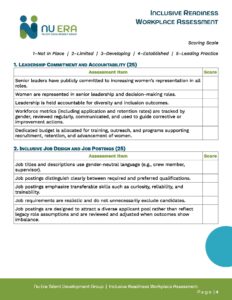 Nu Era Talent Development Group works with companies and organizations across the non-profit, corporate, and government sectors to turn your assessment results into practical action.