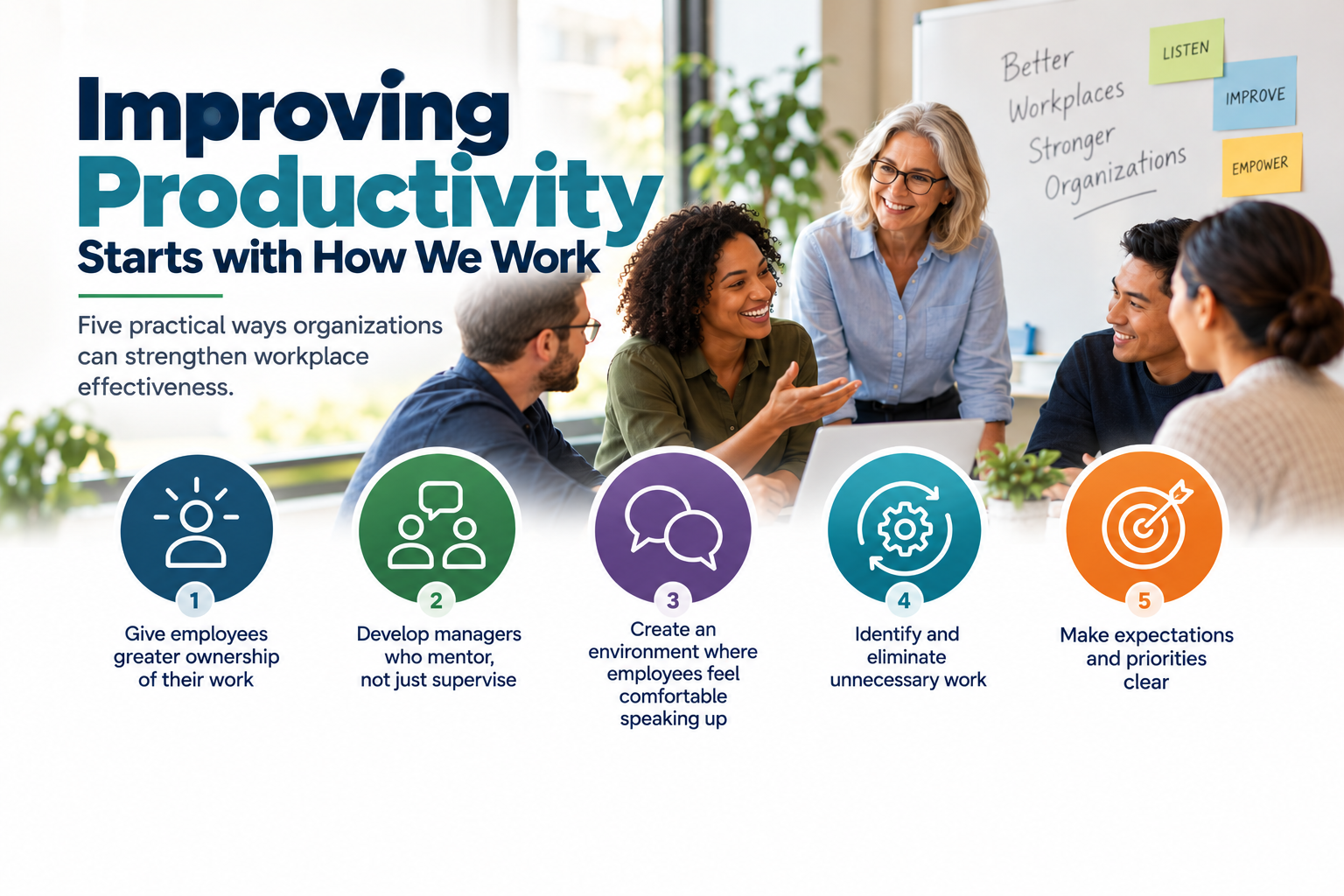
Five practical ways organizations can strengthen workplace effectiveness.
I’ve been giving a lot of thought to workplace productivity lately, particularly as I’ve been following research highlighting how Canada continues to lag behind many other developed countries.
While much of the national conversation focuses on business investment and technology adoption, I’ve been particularly interested in another aspect of productivity: how we lead, support, and organize people in our workplaces.
Time and time again, I come across reports sharing examples of Canadian businesses finding ways to improve productivity through changes to their operations, investments, and workplace practices. One theme that consistently stands out to me is the importance of listening to employees, valuing their insights, and involving them in identifying opportunities for improvement.
It reinforces something I’ve observed throughout my work with organizations: Some of the biggest barriers to workplace effectiveness aren’t necessarily complicated. They’re often found in the everyday experiences of employees and managers.
Unclear expectations. Inconsistent onboarding. Communication gaps. Inefficient processes. Missed opportunities to develop people.
Individually, these challenges may seem relatively minor. Collectively, however, they can affect employee engagement, organizational performance, and ultimately, productivity.
What if improving productivity isn’t about asking people to do more?
What if it’s about helping them work more effectively?
Research on employee engagement, management practices, and organizational performance suggests that how we lead, organize, and support people can make a meaningful difference to workplace productivity.
And the good news?
Improving workplace effectiveness doesn’t always require significant financial investment.
Sometimes it’s about making small, intentional changes to how work gets done.
Here are five practical approaches worth considering.
1. Give employees greater ownership of their work
Employees are often more engaged when they have a sense of ownership over their responsibilities and the freedom to make decisions.
Establish clear expectations, then give employees appropriate autonomy in how they achieve results.
Empowering people to make decisions can reduce unnecessary approvals, encourage initiative, and help work move forward more efficiently.
It’s about providing direction without controlling every step.
2. Develop managers who mentor, not just supervise
Managers have a significant influence on employee engagement, development, and team effectiveness.
Yet many people move into management positions because they’re good at their jobs, without necessarily receiving the support or development needed to lead others.
I believe one of the most valuable things organizations can do is encourage managers to become mentors.
That means sharing knowledge, providing guidance, recognizing strengths, encouraging growth, and helping employees develop the confidence to succeed.
When managers invest in developing their people, they’re also investing in the organization’s future capabilities.
3. Create an environment where employees feel comfortable speaking up
Employees are often the first to recognize inefficient processes, communication gaps, and opportunities for improvement.
But recognizing a problem and feeling comfortable raising it are two very different things.
Employees need to trust that their perspectives will be welcomed and that sharing concerns won’t result in negative consequences.
This is particularly important when asking employees to identify workplace barriers or challenges involving their managers.
Consider creating opportunities for private feedback through individual conversations or thoughtfully designed anonymous surveys, where anonymity can genuinely be protected.
Most importantly, listen without becoming defensive and demonstrate that employee feedback leads to meaningful consideration and action.
Employees are more likely to contribute ideas when they believe their voices matter.
4. Identify and eliminate unnecessary work
Productivity isn’t always about doing more.
Sometimes it’s about doing less of what doesn’t add value.
Think about the everyday processes that employees navigate.
Are people duplicating work? Searching for information that should be readily available? Waiting for approvals that aren’t necessary? Following procedures that no longer serve a useful purpose?
These inefficiencies consume time and energy that could be directed toward more meaningful work.
Sometimes improving productivity starts with asking a simple question:
“Why are we still doing it this way?”
5. Make expectations and priorities clear
Employees perform more effectively when they understand their responsibilities, what success looks like, and how their contributions support organizational goals.
Yet unclear expectations are surprisingly common.
When responsibilities overlap, priorities constantly shift, or employees receive inconsistent direction, frustration and inefficiency can follow.
Clear communication, well-defined responsibilities, and regular conversations about priorities help employees focus their efforts where they matter most.
Clarity doesn’t eliminate every workplace challenge, but it creates a stronger foundation for success.
Where should organizations begin?
I believe one of the simplest and most valuable places to start is by asking employees a question:
“What’s one thing we could change that would make it easier for you to do your job well?”
Give employees an opportunity to respond privately, whether through individual conversations or a carefully designed survey.
Listen with curiosity.
Look for common themes.
And most importantly, follow through.
Not every suggestion will be practical or possible to implement. But acknowledging feedback, explaining decisions, and making meaningful improvements can strengthen trust and engagement.
Often, the people doing the work have valuable insights into how that work could be done better.
We simply need to create opportunities to hear them.
Better workplaces. Stronger organizations.
Canada’s productivity challenges are complex, and improving workplace practices alone won’t solve them.
But I believe organizations have an opportunity to make meaningful improvements within their own workplaces.
Research and examples from Canadian businesses offer an encouraging reminder that productivity improvements are achievable, and that employees can play an important role in identifying opportunities for change.
We can invest in developing managers, create clearer expectations, remove unnecessary barriers, and build environments where employees feel supported and equipped to succeed.
At Nu Era Talent Development Group, we believe that employee experience and organizational performance aren’t competing priorities. They’re connected.
Creating workplaces where people feel valued, supported, and able to contribute their best isn’t just good for employees.
It’s good for business.
And perhaps improving productivity begins not by asking employees to work harder, but by asking ourselves how we can help them work better.
Further reading: Business Development Bank of Canada (BDC), Canadian Entrepreneurs on Productivity: Insights and Success Stories.
https://www.bdc.ca/en/about/analysis-research/productivity-insights
Nu Era Talent Development Group helps organizations strengthen workplace performance by improving how they onboard, develop, and retain their people.

